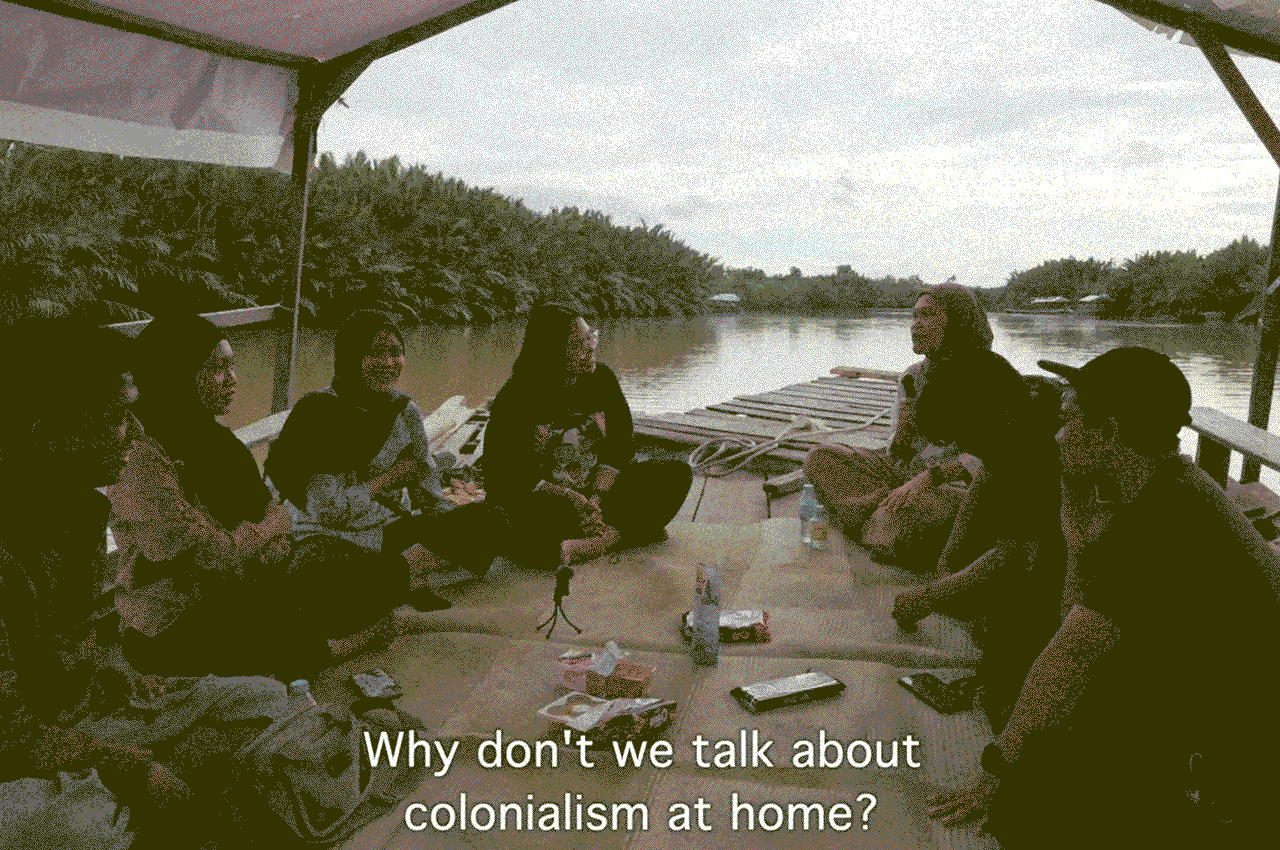
How is history remembered and passed from one generation to another? What is commemorated, what is allowed to disappear, and how does the presence or absence of a monument shape collective memory?
History – Memory – Commemoration is a trilogy of films by Mirwan Andan, Hans van Houwelingen and Iswanto Hartono. Made across Java, Aceh and Sulawesi, the films consider how Indonesia’s colonial history, its struggle for independence and subsequent political violence remain present within contemporary life.
The trilogy moves between monuments and their absence, official histories and lived memories. It listens to the ways the past is transmitted through families, education, religion, fashion and political culture, asking who determines the forms through which history becomes visible.
Across Indonesia, colonial statues were removed and streets renamed following independence, as new monuments were erected to imagine and celebrate a national future. In the Netherlands, many colonial memorials remained and later became sites of controversy.
These different commemorative landscapes raise questions that run throughout the trilogy: What does a society choose to remember? Where does memory reside when monuments disappear? What kinds of violence remain unmarked, and why do particular memorials continue to matter?
The three films have a combined running time of 200 minutes and will play back-to-back. The complete trilogy will be presented in full on Friday and repeated in full on Saturday, allowing audiences to choose which evening to attend or to engage across both evenings.
The Saturday screening takes place alongside Iswanto Hartono’s Lumbung-ing workshop. While workshop participants undertake a Speculative Collective Kitchen downstairs, the films will screen in the studio. Workshop participants may move between the two spaces.
SCREENING TIMES
Friday 2 October, 4.30–8pm Complete trilogy
JAVA, ACEH and SULAWESI, playedback-to-back.
Saturday 3 October, 4.30–8pm Complete trilogy repeated
JAVA, ACEH and SULAWESI, playedback-to-back.
THE FILMS
JAVA
69 minutes / 2024
JAVA was filmed in Jakarta, Depok and Tangerang in 2023. It asks how location, politics, religion, education, family, historiography and fashion influence the ways history is remembered and passed to future generations.
At its centre are the contested memorials to Dutch colonial figures Jan Pieterszoon Coen and Joannes van Heutsz. Monuments to both figures remain in the Netherlands, where their presence has become controversial. Their former Jakarta monuments, by contrast, were demolished in 1943 and 1953.
Following Indonesian independence, President Sukarno ordered the demolition of most colonial statues and the renaming of streets. The new nation turned towards the future, erecting monuments that celebrated independence in place of those that had asserted colonial power.
What does the presence or absence of these monuments signify? How do people remember in places where memorials have disappeared, or where contested statues remain?
ACEH
65 minutes / 2024
Filmed in Banda Aceh in 2023, ACEH explores how history is remembered and commemorated within the region’s distinct cultural and political life.
The commemoration of Acehnese resistance figures such as Tjoet Aja Dhien and Teuku Umar accompanies memories of victory over the Dutch army, including the killing of Dutch general Johan Harmen Rudolf Köhler.
The film also engages with the violence of the Indonesian military’s counter-insurgency campaign against the Free Aceh Movement under the New Order regime. Between 1989 and 1998, the region experienced mass killing, systematic torture and sexual violence.
These histories, and an enduring desire for self-determination, remain present within the outlook of contemporary generations. ACEH considers how religion, politics, education, historiography and fashion shape the ways this history is carried forward.
SULAWESI
66 minutes / 2026
The final film in the trilogy was recorded in Makassar, Barru, Pare-Pare and Palopo in February 2025.
SULAWESI examines how communities remember the atrocities committed by Dutch special forces under Captain Raymond Westerling during Indonesia’s war of independence in 1946–47.
While the national project of independence looked towards a future of freedom, large and imposing memorials were erected across Sulawesi to commemorate those who had been killed.
The film considers the continuing need for these monuments, the histories they make visible and their place within the lives of present-day communities.
Together, the three films ask how the built environment participates in the production of history—and how memory persists through monuments, stories and everyday life.
ABOUT THE FILMMAKERS
Mirwan Andan is a researcher, curator and member of the Jakarta-based artists’ collective ruangrupa. His practice is concerned with collective learning, cultural ecosystems and the relationship between art and social life. Together with ruangrupa, he was part of the Artistic Direction of documenta fifteen in Kassel in 2022.
Hans van Houwelingen is a Dutch artist whose work investigates the role of art in public space, with a particular focus on monuments, political symbolism and the contested construction of collective memory.
Iswanto Hartono is an Indonesian artist and architect working across installation, video, painting, text and site-specific practice. His work revisits histories that have been neglected or consciously forgotten, engaging with colonialism and postcoloniality, political power, race and identity. A member of ruangrupa, he was also part of the Artistic Direction of documenta fifteen.
PRACTICAL INFORMATION
The screenings are free and open to everyone. A Lumbung-ing workshop ticket is not required.
Doors open at 4.15pm. The films begin promptly at 4.30pm and play back-to-back. Each evening presents the complete trilogy and concludes at approximately 8pm.
The programme contains discussion of colonial and military violence, including mass killing, torture and sexual violence.