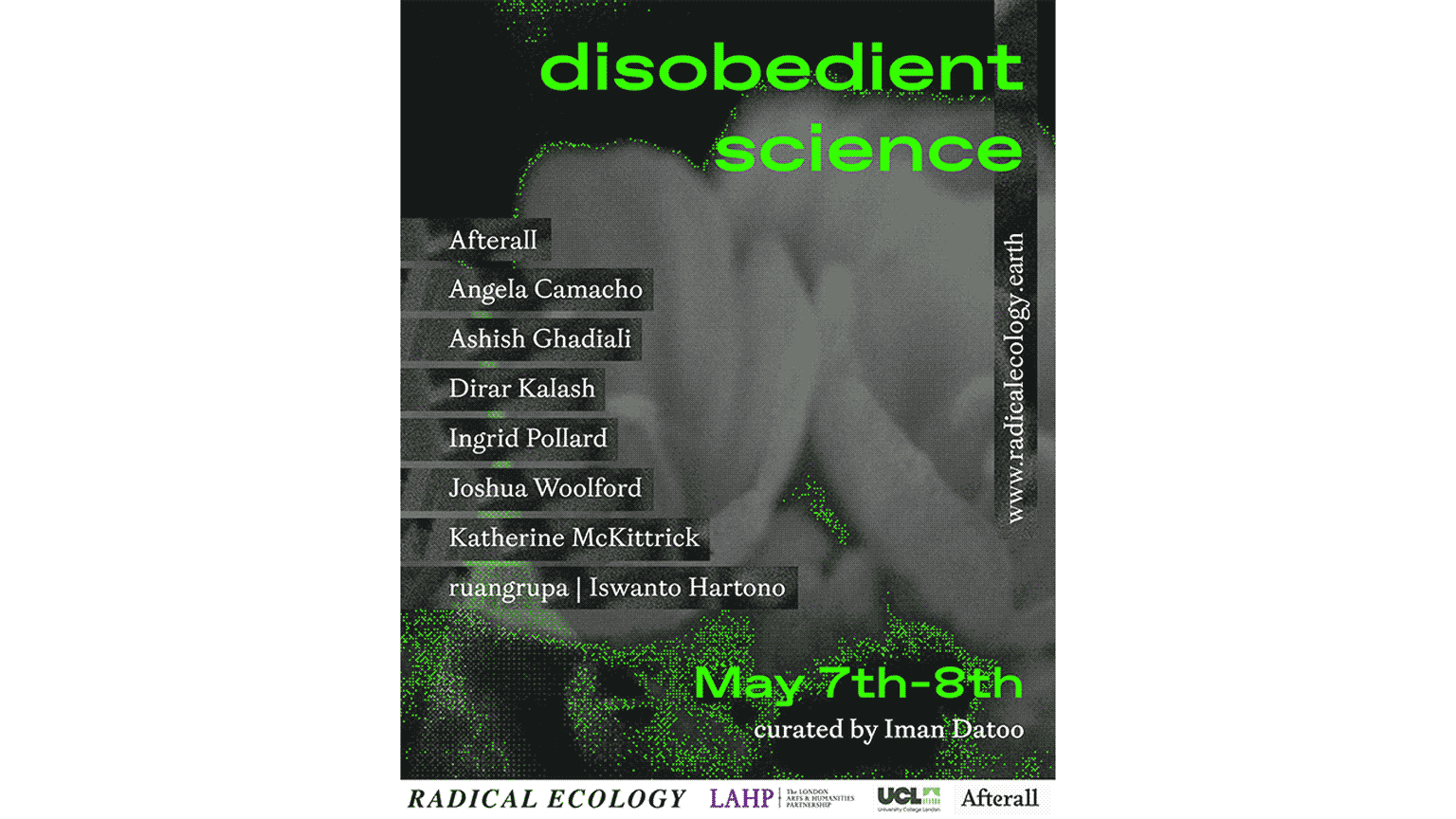
Afterall - Angela Camacho – Ashish Ghadiali – Dirar Kalash – Ingrid Pollard – Joshua Woolford - Katherine McKittrick – ruangrupa - Iswanto Hartono | Curated by Iman Datoo
Register for Day 1 via Eventbrite ↗
Join us for Disobedient Science, a 2-day gathering at Pelican House and Slade School of Fine Art, hosted by Radical Ecology in partnership with UCL, LAHP and Afterall Research Centre on 7-8 May 2026. The programme opens pathways for relational practices in art and activism that move beyond inherited scripts of colonial knowledge production and scientific rationalism, revealing instead how thinking and making are never disembodied, and how lived time and space are touched by scales both intimate and immense: geologic, historic, microscopic and planetary.
On Thursday May 7th (6pm-10:30pm), we’ll be at Pelican House in Bethnal Green, where the evening begins with a relaxed sharing of food and music with Iswanto Hartono from Jakarta-based art collective ruangrupa and Afterall Research Centre, to mark the launch of How to Pin Down Smoke: ruangrupa since 2000. This will be followed by Dreaming Aesthetics, a conversation between artist Ingrid Pollard and writer, academic and editor Katherine McKittrick on Black time, dreaming, and the ongoing, liberatory practice of tending to place, story and land. The programme concludes with a performance by experimental sound-artist Dirar Kalash, connecting collective listening practices to the politics of space and time in Palestine.
Submit your EOI for Day 2 via Google Forms ↗ by 24th April
Day 2 of this gathering takes place at UCL Slade School of Fine Art on Friday May 8th (11am-4pm) and launches Radical Ecology’s new academic network for decolonial ecology, also called Disobedient Science. We invite researchers interested in creative and critical practices that respond to conditions of polycrisis and that think and make between science and art in novel, unpredictable ways to apply to participate in this inaugural meeting by submitting a short expression of interest by 24 April. We have an allowance of up to £100 per researcher for travel and accommodation, available for up to 10 researchers on a needs basis.
The day begins with a preview of On Synchronicity, a film by artist-researcher Ashish Ghadiali, presenting a real-time conversation with Sonu Shamdasani on Carl Jung and Wolfgand Pauli’s theory of synchronicity and its implications for the practice of ecology. Artist & researcher Joshua Woolford will then present a participatory performance, weaving together an evolving live soundscape with a range of texts by authors including Édouard Glissant, Jehan Helou, Fahima Ife and Robin D. G. Kelley.
We’ll break for lunch and then gather for a plenary discussion led by Iman Datoo & Ashish Ghadiali (Network Co-Convenors) to map an emerging ecology of practices, exploring connections across the specific research interests of network members and sharing reflections on the programme and emergent possibilities for ongoing transdisciplinary and translocal collaboration. Artist Angela Camacho will conclude the event by offering a grounding ritual, returning us to questions of time and temporality that run through the programme, and focusing hearts and minds on the setting of intention for what is carried forward.
Afterall is a research centre and publisher based in London. Through research, publishing and programming, it explores contemporary art and its relation to wider society.
Angela Camacho, also known as The Bonita Chola, is an Indigenous artist of Aymara‑Quechua descent, born in Argentina to Bolivian Indigenous parents and based in London. Her work is shaped by migration, ancestral continuity, and survival, and by a sustained commitment to carrying Indigenous knowledge across borders and generations. Working across performance, installation, digital portrait collage, ritual, and participatory projects, Camacho explores Indigenous futurities, ecology, displacement, and identity through sentipensar (a way of knowing) that connects feeling and thinking. She understands art as ceremony and as an intergenerational responsibility, described as “becoming a good ancestor,” shaping how work is made and shared. Through accessible digital tools and collective methodologies, she creates living archives of Indigenous and Black women activists from Abya Yala, countering historical erasure and enabling grassroots transmission of knowledge globally. Camacho’s artistic practice did not emerge via conventional institutional pathways. For over ten years she lived undocumented in the UK, navigating precarity, and care work while maintaining a continuous creative and organising practice. These conditions became formative, positioning creativity as a means of survival, resistance, and continuity, even if sustained under conditions of exclusion. Her work has been presented across major cultural institutions and public contexts in the UK and internationally, including Tate Modern, the Southbank Centre, Somerset House, the Barbican Centre, alongside grassroots and community‑led spaces.
Ashish Ghadiali is an artist-researcher whose practice extends through film, writing, performance and sound to include the construction of networks, sites and learning and collaborative infrastructures that are intended to function as living decolonial systems. Much of this work builds on questions of what it means to make art in the context of climate breakdown and on making visible structures that connect climate breakdown’s dystopian futures to its origins in the transatlantic slave trade. He is the founder and director of Radical Ecology and was co-chair of UCL’s Black Atlantic Innovation Network with Paul Gilroy (2022-5) and co-author of the Nature Sustainability study Quantifying the human cost of global warming with Tim Lenton (2023). Film works include Dream Ecologies (2026), On Synchronicity (2026), 7 seconds/this part of world contains a complete world (2025), Can you tell the time of a running river? (2024), Invasion Ecology (2024), Planetary Imagination (2023) and The Confession (2016).
Dirar Kalash is a Palestinian musician and sound artist whose work spans a wide range of musical and sonic practices within a variety of instrumental, compositional and improvisational contexts. He is mostly known for his politically driven soundscape / electro-acoustic project “The Sonic Front”, and the compositions “we can’t breathe (for eric garner, george floyd, and frantz fanon)” and “by any means necessary (for Malcolm X)”
Iswanto Hartono is an artist, curator, architect and exhibition designer whose work explores the intersection of spatial practice, ecology and activism. His research projects explore concepts such as climate justice, decolonial pedagogies, and epistemologies from Global South contexts. He integrates methodologies focused on sustainability, upcycling, and collective design. He has taught at several leading global institutions and is currently pursuing a practice-based PhD at CREAM, University of Westminster, London. He disseminates his research internationally through exhibitions, biennials, and publications. From 1991-1996 he studied architecture in Universitas Tarumanegara, Jakarta and gained ST./B.Arch., then Jakarta Art Institute from 1998 – 2000, unfinished, and gained M.Arch. from School of Planning and Architecture, New Delhi, India (2000-2002). He is a part of ruangrupa, an artist collective based in Jakarta. He was one of the co-Artistic Directors when the collective led Documenta Fifteen/Lumbung #1 in Kassel, Germany, in 2022. Also part of Musyawarah Arsip, an independent platform initiated to identify, store, care for, activate and present archives to the public in various programs and media, based in Makassar, South Sulawesi, Indonesia.
ruangrupa is a contemporary art organization initiated in 2000 by a group of artists in Jakarta. As a not-for-profit organization, ruangrupa strives to encourage progressive art ideas in urban and the extensive cultural context by means of exhibition, festival, art laboratory, workshop, research and books, magazines, and online journal publishing.
Dr Ingrid Pollard, comes from a community arts background and trained in print making, film and photography. Pollard is a multi-media artist, photographer, researcher and lecturer. Pollard has developed a social practice concerned with representation, history and landscape with reference to race, difference and the materiality of lens-based media. Through her practice Pollard uncovers layered histories of representation, making the invisible visible, revealing ‘what we always knew was there’. Pollard has exhibited at Tate Britain, Victoria & Albert Museum & the Photographers Gallery London, NGBK, Berlin, the Caribbean Cultural Centre, New York, the National Art Gallery of Barbados. Recent exhibitions; We have Met Before, (2017), National Gallery of Jamaica, Valentine Days, Autograph ABP (2017), Rivington Place London, Deep Down Body Thirst, Glasgow International, (2018), No Cover Up, Glasgow Women’s Library (2021), Seventeen of Sixty-Eight, BALTIC Newcastle (2019) Three Drops of Blood Thelma Hulbert Gallery (2022), Art Institute of Chicago (2024), Being in Landscape; Futura Gallery Stockholm (2024), Spencer Museum, Kansas University (2025). In 2019 she was a recipient of Baltic Artist’s Award and the Paul Hamlyn Foundation Artists Award. She was granted the Freeland Foundation with MK Gallery for the exhibition Carbon Slowly Turning which was nominated for Turner Prize (2022). She was the recipient of the prestigious Hasselblad Laureat Award (2024) and the Century Medal, Royal Photographic Society (2025)
Joshua Woolford is a transdisciplinary artist working across performance, sound, video, and installation. Joshua’s work is grounded in cultural research and their personal experiences of being a member of the queer Black Afro-Caribbean diaspora living in England. Through their practice, Joshua acknowledges and confronts experiences of violence, aggression, and misalignment through installation, sound, language and their body. They embrace reflection, transition and movement as powerful and disruptive states which provoke critical dialogues. Woolford graduated with an MA from the Royal College of Art (Contemporary Art Practice) and Cum Laude from the Design Academy Eindhoven (Media and Culture). They were the 2023-24 Interpretation Artist in Residence at Tate and a New Contemporaries 2023 Artist. In 2024 Joshua was the recipient of an Arts Council DYCP grant, and the a-n Artists Bursary. Notable exhibitions include live performances at the Van Abbemuseum in Eindhoven, as and exhibitions and performances at various institutions across London, such as HOME by Ronan Mckenzie, Somerset House, Black Cultural Archives, the V&A, Gucci flagship store, Camden Art Centre and Tate Britain.In addition to their artistic practice, Joshua lectures at both UAL (London College of Communication) and the Royal College of Art (School of Architecture), and takes on design commissions.
Katherine McKittrick is Professor of Gender Studies and Canada Research Chair in Black Studies at Queen’s University in Kingston, Canada. She authored Dear Science and Other Stories (DUP, 2021), and Demonic Grounds: Black Women and the Cartographies of Struggle (UMP, 2006). She also edited and contributed to Sylvia Wynter: On Being Human as Praxis (DUP, 2015) and, with Clyde Woods, Black Geographies and the Politics of Place (BTL, 2007). Her writing is also collected in the volume Heartbreak and Other Geographies, edited by Brittany Meché and Camilla Hawthorne (UMP, 2026). Recent projects include the limited-edition boxset, Trick Not Telos (2023, with Cristian Ordóñez and Liz Ikiriko), the limited-edition hand-made book, Twenty Dreams (2024, with Cristian Ordóñez) and the installation honouring nourbeSe philip, A Smile Split by the Stars (Gallery 44, Spring 2025, with Nasrin Himada, Sameen Mahboubi and Cristian Ordóñez).
Iman Datoo is an artist and researcher based in Cornwall. She is currently undertaking an LAHP funded practice-led PhD at UCL’s Slade School of Fine Art, and serves as Head of Research and Community at Radical Ecology. At the centre of Iman’s work is “kinnomics”, a transitional framework that shifts thinking away from an economics of commodification toward making kin with those rendered inert, inanimate, or marginal - whether pathologised soils in mines, invasive species in plantations, colonised specimens in botanical gardens, or artefacts held in museum collections. Through this lens, she invites an understanding of worlds as relative to one another, and foregrounds an intimate planetary existence in which the human is never at the centre but always embroiled in relation. In 2025, she was the Stonecroft Art in Residence with Agnes Etherington Arts Centre and Queen’s University Biological Field Station in Ontario, Canada, and a recipient of the Two Together Residency with Porthmeor Studios and the Freelands Foundation. Her debut solo exhibition Kinnomics opened at the Agnes Etherington Arts Centre in 2025. Recent works include A 100 Year Care Plan (2025), Movement is Natural (2024), A Map of Southcombe Gardens (2024), Kinnomic Botany (2023) and Soil brain-Gut brain (2023).